Pillar Guide
Should you repair or replace your AC? An honest decision guide
For most Oxford County homeowners weighing repair vs replace on an AC, the answer comes down to three numbers: the unit's age, the repair cost, and whether the refrigerant is R-22 or R-410A. Here's how we'd run the math at your kitchen table.
For most Oxford County homeowners weighing repair vs replace on an AC, the answer comes down to three numbers: the unit's age, the repair cost, and whether the refrigerant is R-22 or R-410A. If the AC is over 12 years old, the repair is over $1,000, or the system runs R-22 — replacement usually wins on long-term economics. Otherwise, repair makes sense.
This guide walks through the actual decision the way we'd run the math at your kitchen table, including the refrigerant phase-out wrinkle that's catching a lot of Oxford County homeowners by surprise in 2026.
The short answer
| Situation | Lean toward |
|---|---|
| AC under 10 years old, R-410A, repair under $800 | Repair |
| AC 10-12 years old, R-410A, repair under $600 | Repair |
| AC over 12 years old, any repair over $800 | Replace |
| AC of any age running R-22, refrigerant leak | Replace |
| AC over 15 years old, any major component fails | Replace |
| Furnace is also due for replacement | Replace both — bundle the install |
| Heat pump conversion rebate applies to your home | Replace + convert to heat pump |
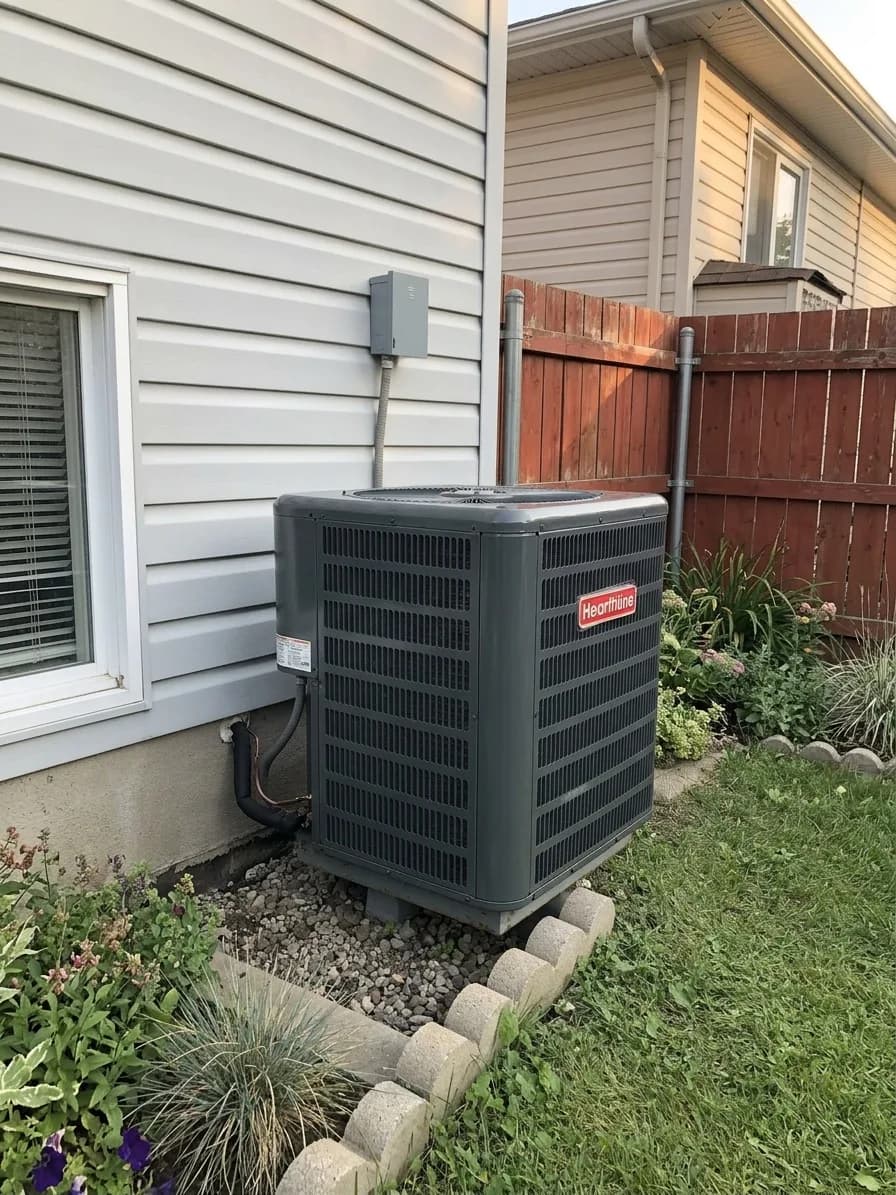
The first thing we look at when we're sitting at your kitchen table is the data plate on the outdoor unit. The refrigerant type and the manufacture date are the two numbers that drive everything else.
The $5,000 rule applied to AC
The simplest first-pass math for repair-vs-replace on any HVAC equipment is the $5,000 rule:
Unit age (in years) × Repair cost = Decision number

If > $5,000: replace
If ≤ $5,000: repair
A few worked AC examples:
| AC age | Repair quote | Calculation | Decision |
|---|---|---|---|
| 6 years | $400 | 6 × 400 = $2,400 | Repair |
| 10 years | $700 | 10 × 700 = $7,000 | Replace |
| 12 years | $500 | 12 × 500 = $6,000 | Replace |
| 14 years | $300 | 14 × 300 = $4,200 | Repair (marginal — see refrigerant note) |
| 18 years | $200 | 18 × 200 = $3,600 | Replace anyway — past typical end of life |
The rule isn't magic; it's a useful gut-check that catches most situations. The cases where the rule doesn't hold are the refrigerant-phase-out scenarios and the safety-issue scenarios.
Why R-22 changes the math
If your AC was installed before 2010, there's a high chance it runs R-22 refrigerant (sometimes called HCFC-22, Freon — though "Freon" is technically a brand name). R-22 has been phased out internationally because of its ozone-depletion impact. As of 2020, no new R-22 has been produced in Canada or the US.
What that means for you: the supply of R-22 is shrinking, recycled stock is dwindling, and the price for refrigerant top-ups has climbed steeply year over year.
A few real-world numbers:
- A 5-lb top-up of R-22 in 2020 ran ~$200–$400
- The same top-up in 2026 runs $400–$900 depending on stock
- Some Oxford County HVAC shops won't take on R-22 leak-repair work at all anymore — too much risk on margins, hard to source clean recovered refrigerant
If your AC runs R-22 and develops a leak, replacement is almost always the better economic call. Topping up a leaking R-22 system is a temporary fix at an escalating cost. The leak will reappear; you'll be back in 12-18 months paying again.
The newer refrigerant (R-410A) is also being phased out — slower, with replacement options like R-454B coming online — but R-410A is still readily available and reasonably priced for the next several years. If your system runs R-410A, the refrigerant pressure isn't a replacement trigger by itself.
How to tell which one your system uses: look at the data plate on the outdoor unit. It'll list the refrigerant type in plain text — "R-22," "HCFC-22," "R-410A," or "Puron" (Puron is Carrier's brand name for R-410A).
Age thresholds — when typical ACs hit end of life
Modern residential ACs typically last 12-18 years. The actual number depends on installation quality, maintenance history, and the local climate:
- 0-8 years: Repair almost always wins. Equipment is mid-life; repairs are typically small.
- 8-12 years: The grey zone. Apply the $5,000 rule. A major component failure tips toward replacement; minor repairs are still worth doing.
- 12-15 years: Approaching end of typical lifespan. Even modest repairs ($500-$800) push toward replacement.
- 15-18 years: Past typical lifespan. Any significant repair is replacement territory.
- 18+ years: On borrowed time. We won't recommend repair over $300-400 because the next failure is around the corner.
The exception: a unit that's been meticulously maintained, well-installed, and run in a mild climate can outperform these ranges. We see a few 22-year-old ACs in Oxford County that are still running — mostly oversized units that haven't been stressed.
Major component failures — the big decision triggers
Some failures are essentially "replace the AC" events even when the rule doesn't mathematically demand it:
- Compressor failure on a unit over 8 years old. The compressor is the most expensive component. Replacement compressors run $1,500-$2,500 plus labour. The total bill on a 10-year-old AC pushes well into replacement territory once you factor in the install labour for the new compressor.
- Coil leak (indoor or outdoor) on R-22 systems. Coil replacement is labour-intensive; doing it with phase-out refrigerant is throwing money at a finite-life system.
- Multiple refrigerant top-ups in 2 years. There's a leak. Finding and repairing the leak on an older system is often more expensive than replacement.
- Failed condenser fan motor + failed capacitor + failed contactor in the same season. The unit is signaling broader end-of-life.
We'll diagnose the specific failure, quote the repair, and tell you straight whether the repair will hold or whether you're replacing the AC in 18 months either way.
When repair is still the right call on an older AC
Not every old AC is a replacement candidate. Repair makes sense even on a 12-15 year old unit when:
- The repair is a small consumable item (capacitor, contactor, blower belt)
- Total repair cost is under $500
- The rest of the system is operating in spec (recent tune-up showed clean CO, good pressures, etc.)
- You're planning to replace the AC + furnace as a planned project within the next 1-2 years anyway and just need it to last
- There's no refrigerant issue (R-410A, no leaks)
A 14-year-old AC with a failed start capacitor is a $250 repair. That's not a replacement conversation — that's a fix-and-keep-running call.
When to bundle replacement with furnace work
If your AC and furnace are both nearing end of life, bundling the replacement saves real money:
- Install labour overlaps — the tech is in your basement either way. Doing both at once saves a second mobilization.
- Matched equipment runs better — the new AC and furnace are sized as a system, share the same line set, and the controls are coordinated.
- One commissioning visit — testing and balancing happens once for the whole system.
- Bundle discount — most installs include a bundled-purchase price break on the equipment.
Typical Oxford County bundle math:
- Separate replacements (12 months apart): ~$10,000 furnace + ~$5,500 AC = $15,500
- Bundled replacement (same install visit): ~$13,500-$14,500 for both
If your AC is 12+ years old and the furnace is 14+ years old, the bundle is almost always the more economical play. See our new furnace cost guide for the furnace side of the math.
When to convert to a heat pump instead of replacing AC
The bigger consideration in 2026: should the AC replacement actually be a heat pump install?
A cold-climate heat pump replaces both the AC (in cooling mode) and supplements or replaces the furnace (in heating mode). Current Ontario rebates stack to $5,000-$10,000 off a heat pump install — see our Ontario heat pump rebate guide.
The conversation goes:
- If you'd be replacing the AC anyway, and the furnace is over 10 years old: heat pump conversion is usually the better long-term economics
- If you'd be replacing the AC anyway, and the furnace is under 8 years old: a heat pump that complements the existing furnace (hybrid setup) is worth considering
- If just the AC is end-of-life and the furnace is mid-life and you're budget-constrained: straight AC replacement is the lower-cost path
The full trade-off comparison is in our heat pump vs furnace for Oxford County winters guide.
What an honest diagnostic visit looks like
When we come out to a customer with a struggling AC, here's what we do:
- Diagnose the actual issue (refrigerant pressures, electrical readings, capacitor test, visual inspection)
- Read the unit's data plate — refrigerant type, manufacture date
- Quote the repair price
- Run the $5,000 rule math out loud
- Quote replacement alongside if the rule says replace, or if the data plate says R-22
- If replacement is on the table, also quote a heat pump conversion option with rebate math
- Show you the numbers and let you decide
The answer is sometimes "fix this for $300 and don't worry about it" and sometimes "the repair is $800 on an R-22 system that's going to leak again — here's what a new AC or heat pump costs after current rebates." Both are honest calls. We don't push one over the other.
The numbers — typical 2026 AC replacement cost in Oxford County
For directional ballparks on a like-for-like AC replacement in a typical Oxford County home with intact ductwork:
- Entry-level 13-14 SEER2 AC (2-3 ton): roughly $4,500-$6,500 installed
- Mid-tier 15-16 SEER2 AC (2-3 ton): roughly $5,500-$7,500 installed
- Premium variable-speed AC (16-21 SEER2): roughly $7,500-$10,000 installed
- Cold-climate heat pump (replaces AC + supplements furnace): roughly $8,000-$15,000 installed before rebates
After current Ontario rebates, the heat pump option is often within a few thousand dollars of an entry-level AC — and the heat pump saves significantly on heating bills on top.
Your number will be different. Every home has its own quirks (electrical panel capacity, ductwork condition, line set length, refrigerant compatibility). We quote after we've seen your space.
Common questions
My AC is 8 years old and the compressor just failed. Replace?
Probably yes. Compressor replacement on a unit that's already mid-life rarely makes economic sense once you factor in install labour. The $5,000 rule (8 years × $2,000 compressor repair = $16,000) screams replace. We'd diagnose to confirm it's actually the compressor and not just a capacitor, then quote both options.
Can I just keep topping up R-22 to keep my old AC running?
You can, but it gets expensive fast. Each top-up costs more than the last as R-22 supply shrinks. A leaking R-22 system needs the leak repaired or it'll lose charge again. Most R-22 leak repairs aren't worth doing in 2026 — replacement is cleaner.
What if I just want the cheapest fix?
Tell us at the visit. We'll quote the cheapest fix that'll get the AC running again, with an honest read on how long it's likely to hold. Sometimes the cheap fix is the right call (rental property, you're selling the house, you're budget-constrained right now).
Are AC repair quotes usually accurate?
Yes, on diagnosed work. Quoting AC repair before diagnosis is a red flag — anyone who tells you "your AC repair will cost $X" before they've seen the unit is selling you a price, not a diagnosis. Real quotes are based on what's actually broken.
What about R-454B and newer refrigerants?
R-410A is being phased out in favour of A2L refrigerants like R-454B and R-32 over the next several years. New AC equipment installed in 2026 may use either R-410A (still common) or A2L refrigerants (becoming more common). Both are still widely supported. The phase-out for R-410A is more gradual than R-22 — not a repair-vs-replace driver in 2026.
What if the repair quote is from a different contractor?
Bring it. We'll review the diagnosis, walk through the math, and tell you if the quote looks right or if something's off. We don't require you to use us for the work — we'll give you a straight read either way.
Ready to get a real diagnostic?
We'll come out, diagnose the actual issue, read the data plate, run the repair-vs-replace math, and quote both options where it makes sense. No estimate written in advance, no pressure either way.
Request a service call or read more on the $5,000 rule, AC replacement, or the Ontario heat pump rebate stack. For AC that's currently misbehaving, work through our AC troubleshooting checklist first. Service area: Woodstock + 30-minute radius covering Ingersoll, Tillsonburg, Tavistock, Norwich, Embro, Innerkip, Thamesford, Beachville, Salford, Mount Elgin, Burgessville, and Plattsville.
Common Questions
Frequently asked
When should I replace my AC instead of repairing it?
If the AC is over 12 years old, the repair is over $1,000, or the system runs R-22 refrigerant — replacement usually wins on long-term economics. The $5,000 rule applies: multiply age × repair cost, replace if over $5,000. Refrigerant phase-out and major component failures tip the math toward replacement even when the age/cost rule alone says repair.
How does R-22 refrigerant affect the repair-vs-replace decision?
R-22 has been phased out — no new R-22 is produced. Top-ups cost more each year as supply shrinks. A 5-lb top-up that ran $200-$400 in 2020 runs $400-$900 in 2026. Leaking R-22 systems are usually replace-worthy because the leak will reappear and the next top-up costs even more.
How long does an AC typically last?
Modern residential ACs typically last 12-18 years. The variance depends on installation quality, maintenance history, and refrigerant type. R-22 systems (pre-2010) face refrigerant supply issues that often push replacement earlier. Well-maintained R-410A systems can hit the upper end of the lifespan range.
What's the $5,000 rule for AC?
Multiply your AC's age in years by the cost of the proposed repair. If the result exceeds $5,000, replacement is usually the more economical choice. A 10-year-old AC needing a $700 repair (10 × $700 = $7,000) crosses the threshold. A 6-year-old AC needing the same $700 repair (6 × $700 = $4,200) doesn't.
Should I bundle AC replacement with furnace replacement?
If both are nearing end of life (AC over 12 years, furnace over 14 years), bundling saves real money. Install labour overlaps, matched equipment runs better as a system, and one commissioning visit handles both. Typical Oxford County bundle: $13,500-$14,500 for both, versus $15,500+ if replaced separately 12 months apart.
Should I convert to a heat pump instead of replacing the AC?
If you'd be replacing the AC anyway and the furnace is over 10 years old, heat pump conversion is usually the better long-term economics. Current Ontario rebates take $5,000-$10,000 off heat pump installs. The heat pump replaces the AC (cooling mode) and supplements or replaces the furnace (heating mode). See our Ontario heat pump rebate guide for current stack math.