Cost & Pricing
New furnace cost in Oxford County: 2026 pricing guide
A new furnace in Oxford County in 2026 typically runs $4,500 to $9,500 fully installed. We break down what actually drives the price so you know what to expect before you call anyone for a quote.
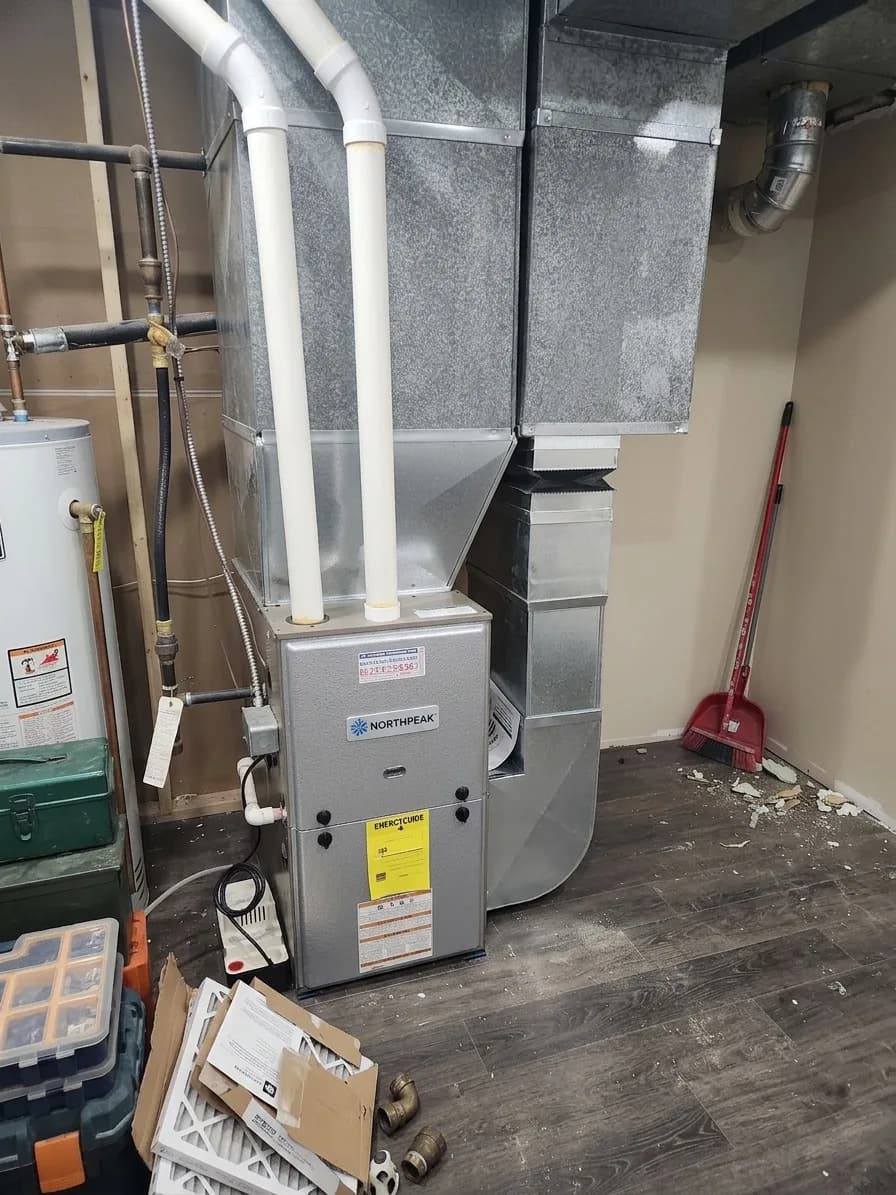
A new furnace in Oxford County in 2026 typically runs $4,500 to $9,500 fully installed. The number depends on size, efficiency, brand, the state of your existing ductwork and venting, and whether you bundle in AC or a heat pump. This guide breaks down what actually drives the price so you know what to expect before you call anyone for a quote.
We service Woodstock, Ingersoll, Tillsonburg, and the 30-minute radius around our home base — so the prices below reflect what real homes in Oxford County are paying, not national averages.
The short version
For a standard 60,000-100,000 BTU single-stage gas furnace replacing a similar existing unit in a typical Oxford County home with intact ductwork:
- Mid-efficiency (80% AFUE): No longer sold new in Ontario as of January 2010 — every replacement furnace is high-efficiency by code.
- Entry-level high-efficiency (95% AFUE, single-stage): roughly $4,500–$5,800 installed
- Mid-tier high-efficiency (96–97% AFUE, two-stage): roughly $5,500–$7,500 installed
- Premium high-efficiency (98% AFUE, variable-speed/modulating): roughly $7,000–$9,500 installed
These are real ballparks for a like-for-like swap. Add cost for ductwork rework, electrical upgrades, chimney liner replacement, or larger BTU sizing.
What drives the price
1. Efficiency rating (AFUE)
AFUE — Annual Fuel Utilization Efficiency — tells you what percent of your gas bill becomes heat. A 95% AFUE furnace turns 95 cents of every dollar into useful heat; the other 5 cents goes out the exhaust.
In Ontario, the minimum AFUE for new residential furnace installs is 95%. Going from 95% to 98% costs more upfront but saves on the gas bill — for most Oxford County homes the payback is 5-8 years, and current rebates can shorten that further. See our Ontario rebates page for what's live.
2. Single-stage, two-stage, or modulating
- Single-stage furnaces are either fully on or fully off. Cheapest. Works fine. Less even temperature.
- Two-stage furnaces run at low fire most of the time and switch to high fire when it's really cold. Quieter, more even, slightly better efficiency.
- Modulating (variable-capacity) furnaces continuously adjust their output between 35% and 100%. The most even temperature and the quietest operation. Pricier.
For most Oxford County homes a two-stage gives the best comfort-to-cost ratio. Modulating makes sense for larger homes or homeowners who want the quietest possible system.
3. Size (BTUs)
A furnace too big for your home will short-cycle — rapid on/off cycles — which is loud, wears the unit down faster, and produces uneven heating. A furnace too small will struggle on the coldest January nights.
Proper sizing is by Manual J heat-load calculation, which accounts for your home's insulation, window quality, square footage, and orientation. We don't size by square-footage rules-of-thumb — that's how homes end up with oversized equipment.
Typical Oxford County home BTU ranges:
| Home size | Typical BTU range |
|---|---|
| Smaller 1,000–1,500 sq ft bungalow | 40,000–60,000 BTU |
| Average 1,500–2,500 sq ft 2-storey | 60,000–80,000 BTU |
| Larger 2,500–3,500 sq ft home | 80,000–100,000 BTU |
| 3,500+ sq ft with poor insulation | 100,000+ BTU |
4. Brand
Carrier, Lennox, Trane, Goodman, Daikin, Rheem, Bryant — the big-name brands all make reliable equipment in 2026. Real-world differences come down to:
- Parts availability when something breaks years down the road
- Warranty terms (most are 10 years on parts, lifetime on heat exchanger)
- Distributor support in Ontario (some are stronger here than others)
Goodman tends to be the value pick. Carrier and Lennox sit at the premium end. We'll quote what makes sense for your home — we don't lead with one brand to push you into it.
5. Ductwork
If your ductwork is sized properly and reasonably sealed, a furnace swap doesn't need duct modifications. If it's undersized, leaky, or has bad transitions, expect $500–$2,500 in additional ductwork to make the new furnace breathe properly.
We check this at the quote and tell you straight whether your ducts are ready as-is.
6. Venting
Most pre-1995 homes vented through the chimney. Modern high-efficiency furnaces vent through PVC pipe directly to the outside (the exhaust is too cool for a chimney — it'll condense and damage the masonry).
If you're going from mid-efficiency to high-efficiency, expect new PVC venting to be cut through the house wall. That's usually $300–$700 of additional install work. If the old chimney was also venting a hot water tank, that tank may need an updated liner or replacement — call that out at the quote.
7. AC, heat pump, or maintenance plan bundles
Replacing the furnace is also a logical time to deal with an aging AC (saves a service call, lets us match the systems for efficiency) or add a heat pump (rebate-eligible, drops gas bills significantly). Many homeowners bundle this; others don't. We quote both ways so you can choose.
Ontario rebates can take a real chunk off
As of 2026, several programs reduce the out-of-pocket cost on high-efficiency furnaces and heat pumps:
- Enbridge HER+ — rebates on high-efficiency furnaces stacked with insulation/envelope work
- Federal Greener Homes successor program — heat-pump-focused, but high-efficiency furnaces qualify in certain scenarios
- IESO programs — periodic incentives, especially around smart thermostats
The rebate landscape changes quarterly. See our current rebates page for what's active right now and what eligibility looks like. We design jobs with current eligibility factored in — we don't spec equipment that locks you out of a rebate.
What "installed" actually includes
When we quote a furnace at a price, that includes:
- The furnace itself
- Delivery and proper handling (the unit is heavy)
- Removal and disposal of the old unit
- Connection to existing gas line and electrical
- Venting to code (new PVC if upgrading from chimney venting)
- Condensate drain
- Thermostat connection
- Commissioning (test fire, leak test, combustion analysis)
- TSSA-compliant gas connection and labeling
- Permit if required by your municipality
What it doesn't automatically include (and shouldn't — they're separate work):
- Ductwork modifications
- Electrical panel upgrades
- Chimney liner work (if applicable)
- New thermostat hardware (if you want a smart thermostat)
- A second-zone damper setup
- Whole-home humidifier (we'll quote alongside if you want one)
We itemize each of these in the quote so you see exactly what's in and what's extra.
Repair or replace?
If your current furnace is over 15 years old and the repair quote is over $1,500, replacement usually wins on long-term cost. A rough check: multiply the unit's age in years by the repair cost. If that number is over $5,000, replacement is the more economical move — see our explainer on the $5,000 rule for HVAC.
If the heat exchanger is cracked — non-negotiable. Shut the unit off and call. Cracked heat exchangers can leak carbon monoxide into your living space; we won't patch a cracked exchanger because it isn't safe to do so.
How to read a furnace quote
A real furnace quote should list:
- The make and model of the furnace
- The BTU size
- The AFUE rating
- Whether it's single-stage, two-stage, or modulating
- Specific venting and gas-line work included
- Specific ductwork modifications (or "no modifications required" if it's a clean swap)
- The warranty terms
- A clear breakdown of price for furnace, install labour, and any extras
If a quote just says "high-efficiency furnace, $X,000 installed" with no model number or details — ask for the specs in writing before you sign anything. The cheap-looking quote is often the one that omits ductwork or venting work the install will actually require.
Ready for a real quote?
If your furnace is 15+ years old, making new sounds, short-cycling, or your gas bill is creeping up — it's worth a real diagnostic visit. We diagnose first, quote second. No estimate written in advance, and the quote you sign off on is the invoice you pay.
We service Woodstock, Ingersoll, Tillsonburg, Tavistock, Norwich, Embro, Innerkip, Thamesford, Beachville, Salford, Mount Elgin, Burgessville, and Plattsville. See our full service area for the complete list.
Common Questions
Frequently asked
How much does a new furnace cost in Oxford County?
For a standard furnace replacing a similar existing unit in a typical home with intact ductwork: entry-level high-efficiency (95% AFUE single-stage) runs roughly $4,500–$5,800 installed; mid-tier two-stage runs $5,500–$7,500; premium variable-speed runs $7,000–$9,500. Add cost for ductwork rework, electrical upgrades, or chimney liner replacement.
What size furnace do I need?
Proper sizing is by Manual J heat-load calculation, not square-footage rules-of-thumb. Typical Oxford County homes need 40,000–60,000 BTU for smaller bungalows (1,000–1,500 sq ft), 60,000–80,000 BTU for average 2-storey homes (1,500–2,500 sq ft), and 80,000+ BTU for larger homes. Oversizing causes short-cycling and uneven heat.
Should I get a high-efficiency furnace?
For most Oxford County homes, yes. The minimum AFUE for new residential furnace installs in Ontario is 95%. Going from 95% to 98% saves 5-10% on the gas bill. With current rebates the payback is typically 5-8 years.
What rebates apply to a new furnace in Ontario?
Enbridge HER+ offers rebates on high-efficiency furnaces stacked with insulation work. The federal Greener Homes successor program covers heat pumps and certain high-efficiency furnace scenarios. The current eligibility shifts quarterly — see our rebates page for what's live now.
What's included in an installed furnace price?
The furnace itself, delivery and handling, removal of the old unit, gas line and electrical connection, code-compliant venting, condensate drain, thermostat connection, TSSA-compliant gas connection, commissioning (test fire + combustion analysis), and any required municipal permit. Ductwork modifications, electrical panel upgrades, and chimney liner work are separate.
When is it worth replacing vs repairing?
A rough check: multiply the unit's age in years by the repair cost. If over $5,000, replacement is usually the more economical move. If the heat exchanger is cracked, replace regardless of age — cracked exchangers are a safety issue.