Pillar Guide
What size furnace do I need for my Ontario home?
Most Oxford County homes need between 40,000 and 100,000 BTU of furnace capacity — 40,000-60,000 BTU for a small bungalow, 60,000-80,000 BTU for an average 2-storey, 80,000-100,000 BTU for a larger home. Right sizing requires Manual J, not square-footage shortcuts.
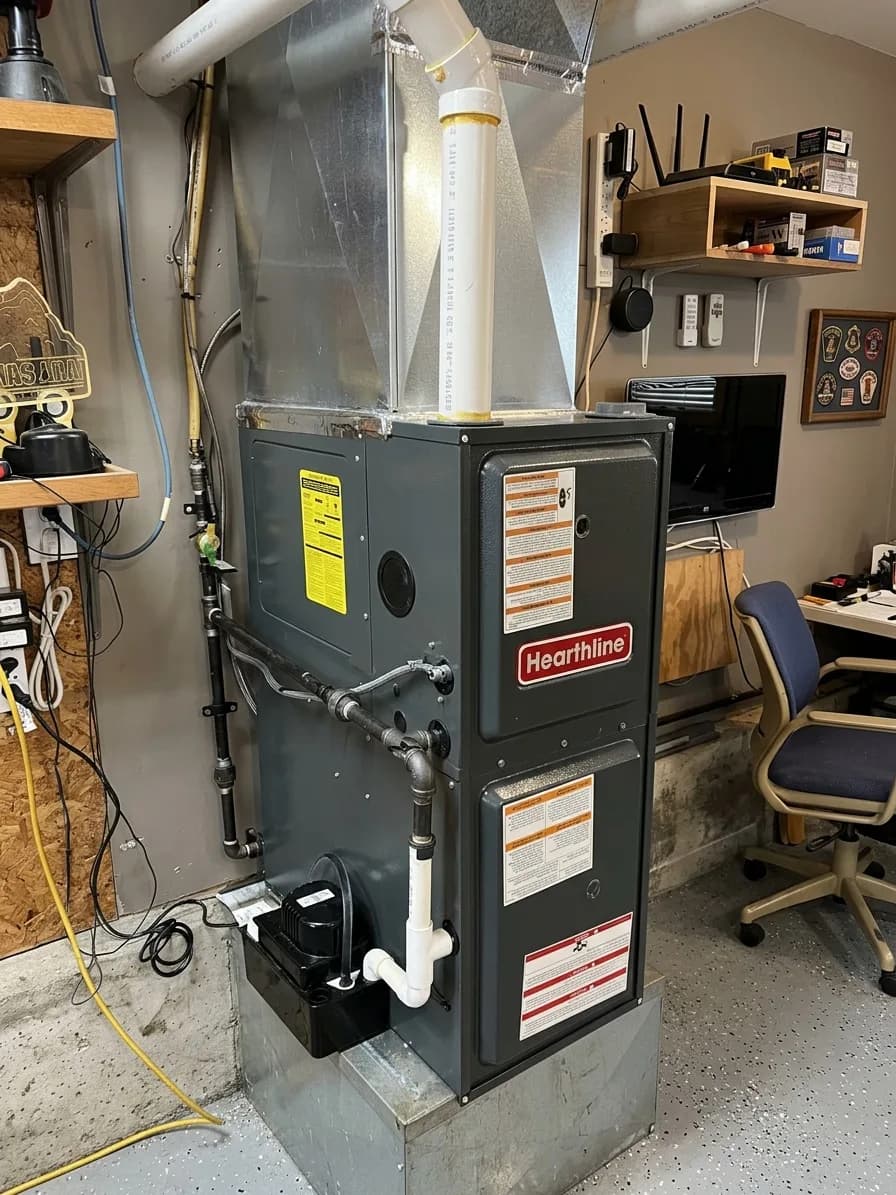
Most Oxford County homes need between 40,000 and 100,000 BTU of furnace heating capacity — 40,000-60,000 BTU for a small bungalow, 60,000-80,000 BTU for an average 2-storey, 80,000-100,000+ BTU for a larger or poorly-insulated home. The right number for your specific home comes from a Manual J heat-load calculation, not a square-footage shortcut. Oversizing a furnace causes short-cycling, uneven heat, and wear; undersizing leaves you cold on the coldest January nights. Both are common — and both are avoidable with proper sizing.
This guide explains how furnace sizing actually works, typical BTU ranges for Oxford County homes by size and vintage, and what to ask a contractor to know if they're sizing correctly.
The short version
| Home size | Typical BTU range | Reason |
|---|---|---|
| Small bungalow 1,000-1,500 sq ft | 40,000-60,000 BTU | Compact footprint, lower envelope loss |
| Average 2-storey 1,500-2,500 sq ft | 60,000-80,000 BTU | Standard build, moderate envelope |
| Larger 2-storey 2,500-3,500 sq ft | 80,000-100,000 BTU | More envelope area, more heat loss |
| 3,500+ sq ft or poor insulation | 100,000-120,000 BTU | Either large footprint or high envelope loss |
| Older drafty pre-1970 build | Often +20% over typical | Higher air infiltration |
These are starting-point ranges, not specifications for your home. Two homes the same size can need different furnace BTU based on insulation, window quality, ceiling height, air leakage, and orientation. A proper Manual J accounts for all of these.
What "BTU" actually means for furnaces
BTU stands for British Thermal Unit — a measure of heat energy. Residential furnaces are typically rated by input BTU/hr (how much gas they burn per hour) and output BTU/hr (how much actual heat reaches your home, after efficiency losses).
The difference between input and output is determined by the furnace's AFUE rating. A 100,000 BTU/hr input furnace at 96% AFUE produces 96,000 BTU/hr of usable heat. The other 4,000 BTU goes out the exhaust.
When we talk about "what size furnace do I need," we usually mean input BTU — because that's how furnaces are catalogued and sold. But what matters is whether the output BTU matches your home's heat load at design temperature.
What "design temperature" means in Oxford County
The design temperature is the temperature your furnace needs to be able to heat your home at. It's set as the temperature your area experiences for roughly the coldest 1% of hours each year.
For Oxford County, the design temperature is approximately -18°C (about 0°F). We hit -18°C several nights each winter, with occasional drops to -25°C in deep January or February.
A correctly-sized furnace produces enough heat at design temperature to maintain 21°C indoor temperature on those coldest nights — running near 100% capacity to do so. If the furnace is sized for warmer weather, it can't keep up in deep cold. If sized for colder than design, it short-cycles in mild weather.
Why proper sizing matters
The instinct is "bigger is better — more capacity means warmer house." It's wrong. An oversized furnace causes more problems than an undersized one:
Short-cycling
An oversized furnace heats the air fast — sometimes the air at the supply register reaches setpoint temperature in 4-6 minutes — and shuts off. Then the house cools, the cycle repeats. Every short cycle stresses the igniter, flame sensor, and gas valve. See our furnace short cycling causes and fixes for the full picture.
Uneven heating
Short cycles mean the system never runs long enough to push warm air to the far corners of the house. Rooms farthest from the air handler stay cold; rooms nearest get overheated.
Wasted gas
Each ignition cycle is the least efficient part of the furnace's operation. Short-cycling burns gas at start-up rates over and over rather than running long efficient cycles.
Reduced lifespan
A furnace that ignites 30 times a night for 15 years racks up far more thermal cycles than one that ignites 8 times a night for 15 years. Components wear out faster.
Excess noise
Oversized furnaces produce more airflow than the ductwork is designed for. The result is whistling, vibration, and louder operation.
Premium price for worse performance
A 100,000 BTU furnace costs $500-$1,500 more than a 60,000 BTU furnace. Paying that premium to get a system that performs worse is a clean lose.
Humidity issues (counterintuitive)
Short-cycling can't maintain consistent humidification. The cycles are too short for whole-home humidifiers (which depend on continuous airflow over the humidifier pad) to do their job. Result: dry winter air despite running a humidifier.
The classic complaint — "my furnace blasts on for a few minutes and shuts off, and some rooms are cold while others are too hot" — is almost always an oversized furnace.
Manual J — the right way to size a furnace
Manual J is the residential heat-load calculation method published by the Air Conditioning Contractors of America (ACCA). Same calculation method used for AC sizing — see our AC sizing guide for the parallel discussion.
A proper Manual J accounts for:
- Square footage by room (not just whole-house)
- Ceiling height (cathedral or vaulted ceilings change the volume)
- Insulation in walls, attic, basement, rim joists (R-values)
- Window count, size, orientation, and quality (single-pane vs double-pane vs triple-pane)
- Door count and quality
- Air infiltration rate (how leaky the house is)
- Foundation type (slab vs basement vs crawl space)
- Internal heat gains (lighting, appliances)
- Local climate design temperatures (for Oxford County, ~-18°C heating design)
The output is a specific heating BTU requirement at design temperature. A proper Manual J takes 30-90 minutes for an experienced tech using software (Wrightsoft, Elite Software, RHVAC).
A "rule of thumb" sizing — 30 BTU per square foot, or "match the existing furnace" — takes 2 minutes and usually oversizes by 25-50%.
What the square-footage rules get wrong
The most common rule of thumb: "30-40 BTU per square foot" or "1 BTU per square foot for newer homes." Both are wrong for almost every Oxford County home, in either direction.
Newer well-insulated homes (post-2010)
The rule oversizes these significantly. A modern 2,200 sq ft 2-storey with R-60 attic insulation, R-24 walls, triple-pane windows, and proper air sealing might need 50,000-65,000 BTU — not the 75,000-90,000 BTU the rule suggests.
Older drafty homes (pre-1980)
The rule sometimes undersizes these. A 1960s 1,800 sq ft farmhouse with original windows, R-8 walls (or worse), and significant air leakage might need 80,000-100,000 BTU despite the rule's 55,000-70,000 BTU prediction.
Cathedral ceilings, high air leakage, exposed exteriors
The rule has no way to account for these. A 1970s 1,200 sq ft bungalow on a windy exposed site can have heat losses far above what its footprint suggests.
The rule of thumb was invented when houses were leakier, insulation was minimal, and the variation between homes was smaller. Modern building envelopes broke the rule. Smart contractors don't use it.
Typical Oxford County furnace numbers — by vintage and size
These ranges assume reasonable insulation and standard ductwork. Your specific home's number depends on Manual J output:
| Home vintage | 1,200 sq ft | 1,800 sq ft | 2,400 sq ft | 3,000 sq ft |
|---|---|---|---|---|
| Pre-1970 (original windows, R-12 walls, drafty) | 60,000 BTU | 80,000-100,000 BTU | 100,000-120,000 BTU | 120,000+ BTU |
| 1970-1990 (some upgrades, mostly original) | 50,000-60,000 BTU | 70,000-80,000 BTU | 90,000-100,000 BTU | 100,000-120,000 BTU |
| 1990-2010 (better insulation, vinyl windows) | 40,000-50,000 BTU | 60,000-70,000 BTU | 70,000-80,000 BTU | 90,000-100,000 BTU |
| Post-2010 (good envelope, double or triple-pane) | 40,000 BTU | 50,000-60,000 BTU | 60,000-70,000 BTU | 70,000-80,000 BTU |
| Net-zero or passive house | 20,000-30,000 BTU | 30,000-40,000 BTU | 40,000-50,000 BTU | 50,000-60,000 BTU |
These are typical, not guaranteed. A 1990s home with major addition work or improved envelope might need to be sized like a post-2010 home. A 1970s home with deep retrofit insulation might fit the 1990-2010 range.
How to tell if your existing furnace is sized right
Before you replace, look at how the current furnace is behaving. A correctly-sized furnace:
- Runs in 15-25 minute cycles on a cold day (not 5-10 minute short cycles, not constant runs without cycling off)
- Keeps the whole house within 1-2°C of setpoint (no 4°C swings between rooms)
- Reaches setpoint within 30-60 minutes of a 3°C bump request (not 2 hours, not 5 minutes)
- Doesn't cycle on every 8-10 minutes in mild weather (50-100% cycle time on a 0°C day is normal; 5-minute cycles every 8 minutes is short cycling)
If your existing furnace has been short-cycling, leaving rooms cold, or running with the blower constantly on — the replacement is your chance to right-size. The data plate on the existing furnace is also a clue: a 100,000 BTU furnace on a 1,400 sq ft post-2000 home is almost certainly oversized.
What about AFUE?
AFUE — Annual Fuel Utilization Efficiency — measures what percent of the gas burns into usable heat vs goes up the exhaust. For Ontario new installations, the minimum is 95% AFUE.
AFUE doesn't change the input BTU sizing decision — a 60,000 BTU input furnace at 95% AFUE produces 57,000 BTU of heat; a 60,000 BTU input at 98% AFUE produces 58,800 BTU. The difference at the same input rating is small.
What matters more for sizing is matching the output to the home's load. A 60,000 BTU input / 96% AFUE furnace producing ~57,600 BTU output is the right answer for a typical 1,800 sq ft Oxford County 2-storey from the 1990s — the AFUE is the efficiency, the input BTU is the capacity.
For the broader furnace cost picture, see our new furnace cost in Oxford County guide.
Single-stage vs two-stage vs modulating — and sizing
How the furnace modulates output affects how forgiving the sizing is:
- Single-stage furnaces are either fully on or fully off. Output is the rated BTU/hr. Sizing has to be tight — too big means short-cycling.
- Two-stage furnaces run at low fire (typically 65-70% of rated capacity) most of the time and high fire (100%) when needed. More forgiving — moderate oversizing still allows the low stage to run reasonable cycles.
- Modulating (variable-capacity) furnaces continuously adjust output between roughly 35% and 100%. Most forgiving — the furnace matches output to actual demand.
Modulating furnaces are the best fit for homes with significant heat load variability (large windows + big sun exposure swings, multi-zone heating, etc.). For most Oxford County homes, a two-stage furnace properly sized via Manual J is the cost-effective choice.
What to ask a contractor about sizing
When you're getting quotes for furnace replacement or new installation, the sizing question separates careful contractors from the eyeball-it crowd. Reasonable questions:
- "How do you determine the furnace BTU?" — Manual J is the right answer. "Same as the old one" is wrong unless you confirm the old one was right. "30 BTU per square foot" is wrong.
- "Will you show me the load calculation?" — A real contractor will share the Manual J output. If they won't, they probably didn't run one.
- "What about my windows / insulation / air leakage?" — If they don't ask about these, they aren't running a real load calc.
- "Is there a chance my existing unit is oversized?" — If they say "we'll match the existing for safety," push back. Most older replacements were sized by the same rule-of-thumb logic that's wrong now.
- "What output BTU at design temperature does this furnace produce?" — A good contractor will quote the output at -18°C and compare to your home's heat load. The numbers should match within 10-20% of the load.
- "What about my ductwork — can it handle the airflow this furnace requires?" — Properly sized furnaces still need ductwork that can move the right amount of air.
A contractor who pushes back with "trust me, you want a 100,000 BTU for safety" is using the wrong sizing approach. Manual J takes under an hour with software.
Why oversized furnaces have been so common
Walk through any Oxford County subdivision built between 1970 and 2010 and you'll find a lot of homes with oversized furnaces. A few reasons:
- Old rules of thumb got passed down through contractor training
- Insulation upgrades happened on existing homes (windows replaced, attic re-insulated) but the furnace was never resized to match
- Adding 20-30% "safety margin" was a sales tactic — bigger furnace, bigger invoice
- Cold-weather worry — "what if it gets to -30°C?" leads to oversizing
- Customer requests — "I want the powerful one" or "I never want to be cold"
- Equipment was less efficient — older 80% AFUE furnaces lost more capacity at cold temperatures, so contractors compensated by upsizing
Today, none of those reasons hold. Modern high-efficiency furnaces maintain capacity better at cold temperatures, insulation upgrades have shrunk loads, and Manual J software is standard.
When a smaller furnace actually fits better
We've replaced more than a few 100,000 BTU furnaces with 60,000 BTU units on Oxford County homes where the original was oversized. The customer's experience:
- House reaches setpoint at the same time, not slower (longer-cycling furnace warms the home steadily rather than blasting then waiting)
- Indoor temperatures stay more consistent room-to-room
- Gas bill drops noticeably (fewer ignition cycles, more time at peak efficiency)
- The furnace is quieter (smaller blower + matched ducts = lower air velocity)
- The humidifier finally works properly (continuous low-stage airflow lets the humidifier pad evaporate water consistently)
The objection we hear: "but won't a smaller furnace struggle on a really cold night?" If sized right via Manual J for Oxford County's -18°C design temperature, no — the furnace runs near 100% capacity for the few coldest nights, which is exactly what it's designed to do.
Sizing for hybrid heat pump setups
If you're considering a hybrid setup (heat pump primary, furnace backup — see our heat pump vs furnace for Oxford County winters guide), the furnace sizing math changes slightly.
In a hybrid:
- Heat pump handles approximately 85-90% of heating hours (mild to moderately cold weather)
- Furnace handles the coldest 10-15% of hours (below about -15°C)
The furnace still needs to be sized for the home's full heating load at design temperature — because on those coldest nights, the furnace is doing all the work. But because the furnace is the backup rather than the primary, sizing flexibility increases. A modulating furnace in a hybrid setup is particularly comfortable.
If you're going pure heat pump (no backup furnace), the heat pump itself must be sized to handle peak heating load. See our heat pump cost in Ontario guide for sizing details.
Common questions
Can I just match the size of my existing furnace?
Only if you confirm the existing one was right. Most replacements we see are oversized — matching perpetuates the problem. Run a Manual J before assuming the old size was correct.
How accurate is Manual J?
Within 5-10% of actual load, which is plenty accurate for sizing. The variability between two correctly-run Manual Js on the same house is small. The variability between Manual J and a square-footage rule is large.
What if my contractor doesn't do Manual J?
Get a different contractor. Sizing without Manual J in 2026 isn't professional practice.
Does ductwork affect furnace sizing?
Yes — but more on the airflow side than the BTU side. Furnaces of different sizes need different airflow rates. Undersized ductwork starves a larger furnace; oversized ductwork doesn't cause problems but wastes some efficiency. A real Manual J includes duct sizing analysis.
Can I oversize on purpose for "growing into" a future addition?
No — install the right size for the current house, then upsize when the addition is built. Running an oversized furnace for years until you get around to the addition wastes money and runs a worse system.
How do I know what my existing furnace's BTU is?
Look at the data plate inside the furnace door or on the side. The "input BTU" rating is what determines size. Common ratings: 40,000 / 60,000 / 80,000 / 100,000 / 120,000 BTU input. Sometimes the rating is written as "40MBH" (thousands of BTU per hour).
What about furnace sizing for very cold microclimates?
If you're in a notably colder pocket of Oxford County (high open exposure, frost-prone valley, etc.), the Manual J should reflect that. Standard Oxford County design is -18°C; some lots see -20°C as the practical design temp. The math accommodates it.
Should I always go modulating for the best comfort?
Modulating is the most comfortable, the quietest, and the most efficient — but it costs $1,500-$3,000 more than a single-stage. For most Oxford County homes, two-stage hits the comfort-to-cost sweet spot. Modulating makes sense for larger homes, homes with high heat-load variability, or homeowners who specifically want premium-tier equipment.
Ready for a proper sizing assessment?
We run Manual J on every replacement and new install quote, included in the visit, no separate charge. We'll look at your home, run the calculation, walk you through the result, and quote the correctly-sized system. If your existing furnace was oversized, we'll show you the math and recommend right-sizing.
Request a quote or read more on furnace installation, furnace replacement, and new furnace cost in Oxford County. For homeowners considering a heat pump conversion alongside furnace work, see our heat pump cost guide and heat pump vs furnace decision guide.
Service area: Woodstock + 30-minute radius covering Ingersoll, Tillsonburg, Tavistock, Norwich, Embro, Innerkip, Thamesford, Beachville, Salford, Mount Elgin, Burgessville, and Plattsville.
Common Questions
Frequently asked
How many BTU furnace do I need per square foot?
There's no accurate per-square-foot rule — it depends on insulation, windows, air leakage, and the home's vintage. Rough Oxford County starting ranges: 40,000-60,000 BTU for 1,000-1,500 sq ft, 60,000-80,000 BTU for 1,500-2,500 sq ft, 80,000-100,000 BTU for 2,500-3,500 sq ft. A proper Manual J calculation produces the specific number for your home.
What is design temperature for furnace sizing?
Design temperature is the temperature your furnace must heat the home at — set as the coldest 1% of hours each year. For Oxford County, design temperature is approximately -18°C (about 0°F). A correctly-sized furnace produces enough heat at design temperature to maintain 21°C indoors, running near 100% capacity on those coldest nights.
Why is an oversized furnace bad?
Oversized furnaces short-cycle (run 4-6 minutes then shut off), produce uneven room temperatures, wear components faster from excess ignition cycles, waste gas at start-up rates, and cause humidity issues (the cycles are too short for whole-home humidifiers to work). The classic 'my furnace blasts on for a few minutes then shuts off and some rooms are cold' complaint is almost always oversizing.
Should I match the size of my existing furnace?
Only if you confirm the existing one was right. Most older furnaces in Oxford County were sized by rule-of-thumb (30-40 BTU per sq ft, or 'add 20% for safety') and are oversized for the current home — especially after insulation upgrades or window replacements. Run Manual J before assuming the old size was correct.
What's the difference between input BTU and output BTU?
Input BTU is how much gas the furnace burns per hour. Output BTU is how much heat actually reaches your home (input × AFUE efficiency). A 100,000 BTU input furnace at 96% AFUE produces 96,000 BTU of heat. When sizing, what matters is whether the output BTU matches your home's heat load at design temperature. Furnaces are typically catalogued by input BTU.
Does AFUE rating affect furnace sizing?
Not the input BTU sizing decision — a 60,000 BTU input furnace at 95% AFUE produces 57,000 BTU output, at 98% produces 58,800 BTU. The difference at the same input rating is small. AFUE affects efficiency (gas bill) more than sizing capacity. For new Ontario installs, 95% AFUE is the minimum legal requirement.