Comparison
HRV vs ERV for Ontario homes: which makes sense?
For most Oxford County homes, an HRV is the right choice — our winters are cold and dry, exactly what HRVs are built for. ERVs make sense in humid climates. This guide walks through how each one works and the actual decision for a Woodstock-area home.
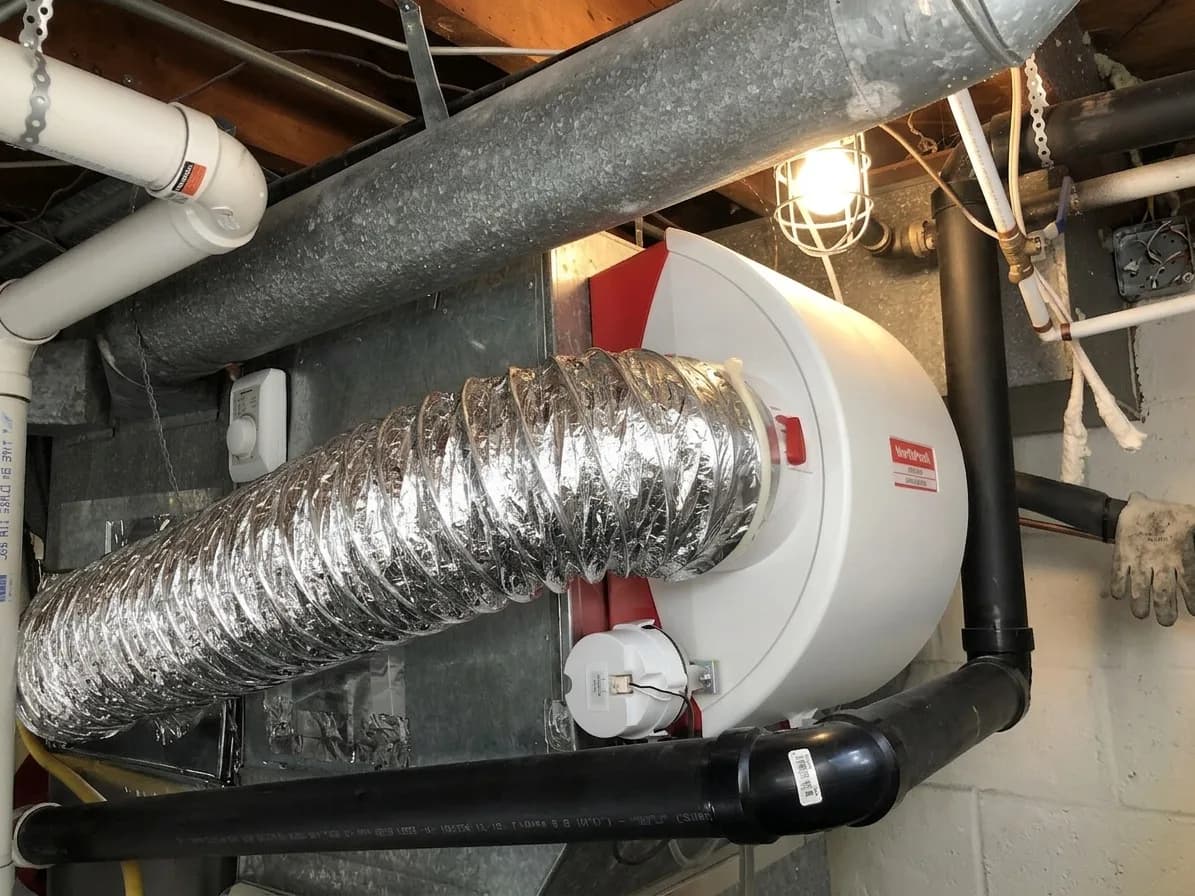
For most Oxford County homes, an HRV is the right choice — our winters are cold and dry, and an HRV is built for exactly that climate. ERVs make sense in humid climates where you want to keep moisture out of the house in summer; in Ontario, the winter problem is bigger than the summer problem, and that's where HRVs shine. This guide walks through how each one works and the actual decision for a Woodstock-area home.
The short answer
| Climate | Best fit | Why |
|---|---|---|
| Cold, dry winters (Oxford County) | HRV | Exhausts stale, moist indoor air; brings in cold, dry outdoor air pre-warmed; doesn't add moisture |
| Hot, humid summers as the dominant concern | ERV | Holds back outdoor humidity in summer; can re-add moisture in winter (sometimes too much) |
| Tight, newly-built homes that struggle with winter humidity | HRV | Helps regulate humidity downward when needed |
| Older, leaky homes with very dry winter air | ERV (occasionally) | Keeps a bit more moisture inside in winter |
For 90%+ of Oxford County homes built in the last 20 years, the HRV is the right answer. We've installed both — the HRV is the workhorse here.
What does an HRV do, exactly?
HRV stands for Heat Recovery Ventilator. It's a small box that lives in your basement or mechanical room, ducted into your home's air handler. Two airflows pass through a heat-exchange core:
- Stale, warm indoor air going out (from bathrooms, kitchen, laundry — the rooms where humidity and odors build up)
- Fresh, cold outdoor air coming in (from outside, distributed to bedrooms and living spaces)
The two airflows never mix. But they pass through a thin-walled core where the heat from the outgoing air transfers to the incoming air. So you're ventilating without losing all your heating energy.
Modern HRV cores recover 70-85% of the heat from the outgoing air. In real numbers: if it's -15°C outside and 21°C inside, the incoming air arrives at the supply registers around 15-18°C instead of -15°C.
What does an ERV do differently?
ERV stands for Energy Recovery Ventilator. Same basic concept — two airflows passing through a core, no mixing — but the core is built to transfer both heat AND moisture.
In summer: humid outdoor air comes in, dry indoor (AC-cooled) air goes out. The ERV transfers some of the outdoor humidity to the outgoing airstream — your indoor air stays drier.
In winter: warm, moist indoor air goes out, cold dry outdoor air comes in. The ERV holds back some of the indoor moisture and transfers it to the incoming air. Your indoor air stays more humid.
That sounds great — until you remember that Oxford County winters are bone dry already, and most homes here are running a humidifier to add moisture back. An ERV in our climate works against the humidifier; the HRV doesn't.
Why HRVs win for Ontario climates
Ontario winters are cold and very dry. The relative humidity outside drops to 20-30% on a typical January day. Inside a tightly-built home running a furnace, the indoor humidity often drops below 25% — which causes dry skin, static, cracked wood floors, and sinus problems.
The standard fix is a whole-home humidifier (we install plenty of them — see our humidifier page). The humidifier adds moisture; the HRV exhausts excess moisture from cooking, showering, and bodies; the net result is a comfortable 35-45% indoor humidity all winter.
An ERV would short-circuit that loop. The ERV recovers moisture from the outgoing exhaust air and pushes it back in — preventing the humidifier from getting the humidity down to the right balance. We've seen ERVs installed in old farmhouses where the homeowner spent the first winter chasing condensation on every window, because the ERV was retaining moisture they didn't need.
If you have a tightly-built, post-2015 build with excellent windows and an attached garage, an ERV occasionally makes sense — those homes can actually be too humid in winter. We assess case by case.
The summer question
The reverse-summer scenario — keeping outdoor humidity out — is a smaller deal in Oxford County than it would be in, say, southern Ontario's lake-effect zones. Yes, August gets sticky. But running an AC plus a high-MERV filter handles most of the summer humidity load. The ERV's summer benefit is modest here.
If you live close to a major lake (we don't — Pittock is small) or in a notably humid microclimate, the summer-humidity argument is stronger. For most of our service area, the winter argument carries.
When you actually need either one
HRVs and ERVs aren't cosmetic. The reason building codes increasingly require them is that modern homes are too tight to breathe without help. Symptoms of a home that needs ventilation:
- Condensation on windows in winter
- Stale smell that doesn't go away even after cleaning
- Bathroom and kitchen fans alone aren't keeping moisture down
- Family members reporting headaches, stuffiness, or asthma flares
- CO2 buildup in bedrooms (you wake up feeling unrested)
- A home built post-2010 with high-efficiency windows and good air sealing
- Indoor air quality concerns from radon, off-gassing, or cooking odors
If your home is from the 1970s with original windows and reasonable air leakage, you might not need either — the house breathes through its own gaps. But anything from 2000 onward with replacement windows is probably tight enough that an HRV makes a real difference.
Install cost — what to expect
Both HRVs and ERVs are similar to install. Rough ranges for an Oxford County install of a mid-tier unit, properly ducted to the air handler:
- HRV (typical): $2,500–$4,500 installed, depending on home layout and ductwork
- ERV (typical): $2,800–$4,800 installed (slightly more expensive than HRV core)
- Premium units (Lifebreath, Venmar Constructo, Panasonic): $4,500–$6,500 installed
Add cost if the install requires running new ductwork to a complex layout, or if the unit needs to be mounted in a spot that requires fitting new wall penetrations for fresh-air intake and exhaust.
These are ballparks. Your home's number will be different — we quote after we've seen the space.
Integration with your existing HVAC
Both HRVs and ERVs tie into your existing forced-air system. There are two install approaches:
- Fully ducted — the HRV has its own supply and return ducts running to bedrooms and bathrooms, independent of the furnace ductwork. Higher install cost; better airflow control; quieter.
- Simplified ducted — the HRV taps into the existing return duct, and distributes fresh air through the existing supply ducts. Lower install cost; works for most homes built with modern HVAC layouts.
For most Oxford County retrofits, the simplified approach is what we use. New builds usually get fully ducted.
The HRV runs on its own timer — typically 30 minutes per hour on default, ramping up to continuous in high-humidity conditions (showers, cooking, sleeping). Some units have CO2 or humidity sensors that auto-trigger.
What you don't need
Sometimes a ventilation pitch gets oversold. A few things that aren't worth the upcharge in our climate:
- Variable-speed HRVs with smart controls — nice, not necessary for most homes. A two-speed unit with a humidity-trigger boost mode covers 95% of the use case.
- UV light add-ons inside the HRV — marketing more than meaningful sterilization. A good filter handles most of what UV claims to handle.
- HRVs with ECM motors as a "must have" — ECM is more efficient than PSC, but the actual annual electricity difference is small. Worth paying for on a premium tier; not the deciding factor at the entry tier.
- Whole-system replacement when only the core is dirty — most HRV/ERV problems can be resolved by cleaning the core, replacing the filter, and clearing the condensate drain. We troubleshoot before we recommend replacement.
What we'll ask at the quote
When we come out to quote an HRV or ERV install, we ask:
- What year was the home built? (drives air-tightness baseline)
- Have you noticed condensation on windows, stale air, or unusual humidity issues?
- Do you already run a humidifier in winter? Dehumidifier in summer?
- Is there an existing air handler / furnace we can tap into?
- Is the mechanical room accessible for the install?
- What's your goal — fresh air, humidity control, both, code compliance for a renovation?
The answers usually point clearly to HRV. Occasionally to ERV. Once in a while to "you don't need either yet."
Common questions
Can I add an HRV to an older home without ductwork?
Yes, but it gets more involved. We'd install dedicated supply and exhaust ducts. Cost goes up by $1,000–$3,000 depending on how much drywall has to come down. For older homes without forced-air, an HRV install becomes a larger renovation project.
How often does an HRV need maintenance?
Twice a year. Pull the filters and rinse or replace them. Wipe down the core (it pulls out for cleaning). Check the condensate drain. We can include this in a maintenance visit alongside furnace or AC tune-ups.
Will an HRV save energy?
It reduces the heat loss from ventilation by 70-85%. If you're currently ventilating by opening a window or running bathroom fans without heat recovery, an HRV cuts that ventilation heat loss significantly. The bill savings are real but modest — the main reason to install one is indoor air quality, not energy savings.
Does an HRV replace bathroom and kitchen exhaust fans?
Mostly, yes — for the bathroom side. A whole-home HRV pulls from bathroom and laundry locations on a continuous low-rate cycle, so the traditional bath fan is less critical (some installs keep them for a high-burst option during showers). Kitchen range hoods are different — for greasy cooking, you still want a dedicated range hood that vents directly outside.
Are HRVs noisy?
Mid-tier and premium units are quiet enough that you'll forget they're running. Cheap units can be noisier. The bigger noise source is usually duct design — undersized supply ducts whistle. We size ducting properly at the install.
What's the lifespan?
Quality HRVs last 15-25 years. The motor is usually the first thing to fail. Replacement HRV motors are available for most major brands; full unit replacement isn't common until the housing or core is well past its prime.
Ready to talk about an HRV or ERV for your home?
We'll come out, look at your home, ask the right questions, and recommend what actually fits — HRV in most cases, ERV in the few cases where it's a better fit, neither if the home doesn't need it yet.
Request a quote or read more about HRV / ERV installation and our broader ventilation services. For homes also looking at heating efficiency upgrades, see the Ontario heat pump rebate guide. Service area: Woodstock + 30-minute radius.
Common Questions
Frequently asked
Should I install an HRV or an ERV in Ontario?
For most Oxford County homes, an HRV is the right choice. Our winters are cold and dry — exactly what HRVs handle well. ERVs retain moisture, which works against the humidifier most Oxford County homes need running in winter. The exception: tightly-built post-2015 homes that struggle with excess winter humidity, where an ERV occasionally makes sense.
What's the difference between an HRV and an ERV?
An HRV (Heat Recovery Ventilator) transfers heat between outgoing stale air and incoming fresh air, recovering 70-85% of heating energy. An ERV (Energy Recovery Ventilator) does the same for heat plus moisture — transferring humidity between airstreams. HRVs work better in cold dry climates; ERVs work better in humid climates.
How much does HRV installation cost in Oxford County?
A typical mid-tier HRV install runs $2,500–$4,500 fully installed in an Oxford County home with existing forced-air ductwork. ERV installs run slightly higher ($2,800–$4,800). Premium units (Lifebreath, Venmar Constructo, Panasonic) can run $4,500–$6,500 installed. Cost varies with ductwork complexity and unit placement.
Does my home need an HRV?
Likely yes if your home was built post-2000 with replacement windows and good air sealing. Modern tight homes don't breathe naturally and develop stale air, window condensation, and humidity issues without mechanical ventilation. Older 1970s homes with original windows often breathe through their own gaps and may not need one. Symptoms of needing ventilation: condensation on windows in winter, stale smell, headaches or stuffiness, CO2 buildup in bedrooms.
How often does an HRV need maintenance?
Twice a year. Pull the filters and rinse or replace. Wipe down the core (it pulls out for cleaning). Check the condensate drain. Often bundled with furnace or AC tune-ups.
Will an HRV save me money on energy bills?
It reduces ventilation heat loss by 70-85%. If you currently ventilate by opening windows or running bath fans without recovery, an HRV cuts that loss meaningfully. The bill savings are real but modest — typically $100-300/year. The main reason to install one is indoor air quality, not energy savings.