Troubleshooting
Furnace not heating? 7 things to check before you call
If your furnace has stopped heating, 5 of the 7 most common causes you can check yourself in under 10 minutes. This is the checklist we walk Woodstock-area homeowners through every winter — about a third of no-heat calls resolve without needing a service visit.
If your furnace has stopped heating, 5 of the 7 most common causes you can check yourself in under 10 minutes — usually before you call anyone. This is the checklist we walk Woodstock-area homeowners through on the phone every winter. About a third of "no heat" calls resolve at one of these steps without needing a service visit.
If it's -20°C outside and your house is dropping below 15°C, work through the checklist quickly, then call. We do same-day service in Woodstock and the close-in towns when scheduling allows — see our furnace repair page for what to expect.
Before you call: the 7-step checklist
1. Check the thermostat
It sounds obvious. It catches a lot of "no heat" calls.
- Is the thermostat set to HEAT (not OFF, not COOL, not AUTO)?
- Is the temperature setting at least 3°C above the current room temperature?
- Did the batteries die? (Pull the cover, check for a battery indicator. Most thermostats need fresh AAs every 12-18 months.)
- For programmable thermostats: did the schedule kick into "away" or "night" mode? Manually override to a higher temp and see if it kicks on.
If the screen is blank, replace the batteries first. If the screen is on but the furnace isn't responding, move to step 2.
2. Check the furnace power switch
There's a switch beside or above your furnace that looks like a regular light switch. It controls power to the furnace. Sometimes it gets bumped off by mistake — kids, cleaning, a stored item leaning against the wall.
- Find the switch (it's usually within arm's reach of the furnace, often on a nearby joist or wall)
- Make sure it's in the ON position
- If it was off, give the furnace 30-60 seconds to start its startup sequence
3. Check the breaker
Your furnace has a dedicated breaker in your electrical panel.
- Find the breaker labeled "Furnace" (sometimes "HVAC" or "Heat")
- Look for one that's sitting in the middle position (between ON and OFF) — that's a tripped breaker
- Flip it fully OFF, then fully ON
- Wait a minute, then check the furnace
If the breaker trips again immediately, stop and call. You have an electrical fault that needs a technician.
4. Check the filter
A completely plugged filter can shut down a furnace via the limit switch — a safety device that detects overheating and shuts off the burner.
- Find the filter (typically at the cold-air return near the furnace, or inside the furnace door — varies by model)
- Pull it out and hold it up to a light
- If you can't see light through it, replace it (any hardware store carries common sizes — write down the dimensions printed on the frame)
- After replacing, wait 5-10 minutes and try the thermostat again
A filter that's been ignored for a year+ can shut a furnace down in a single cold snap. This catches a meaningful number of "no heat" calls.
5. Check the condensate drain
This applies to high-efficiency (95%+ AFUE) furnaces — most furnaces under 15 years old.
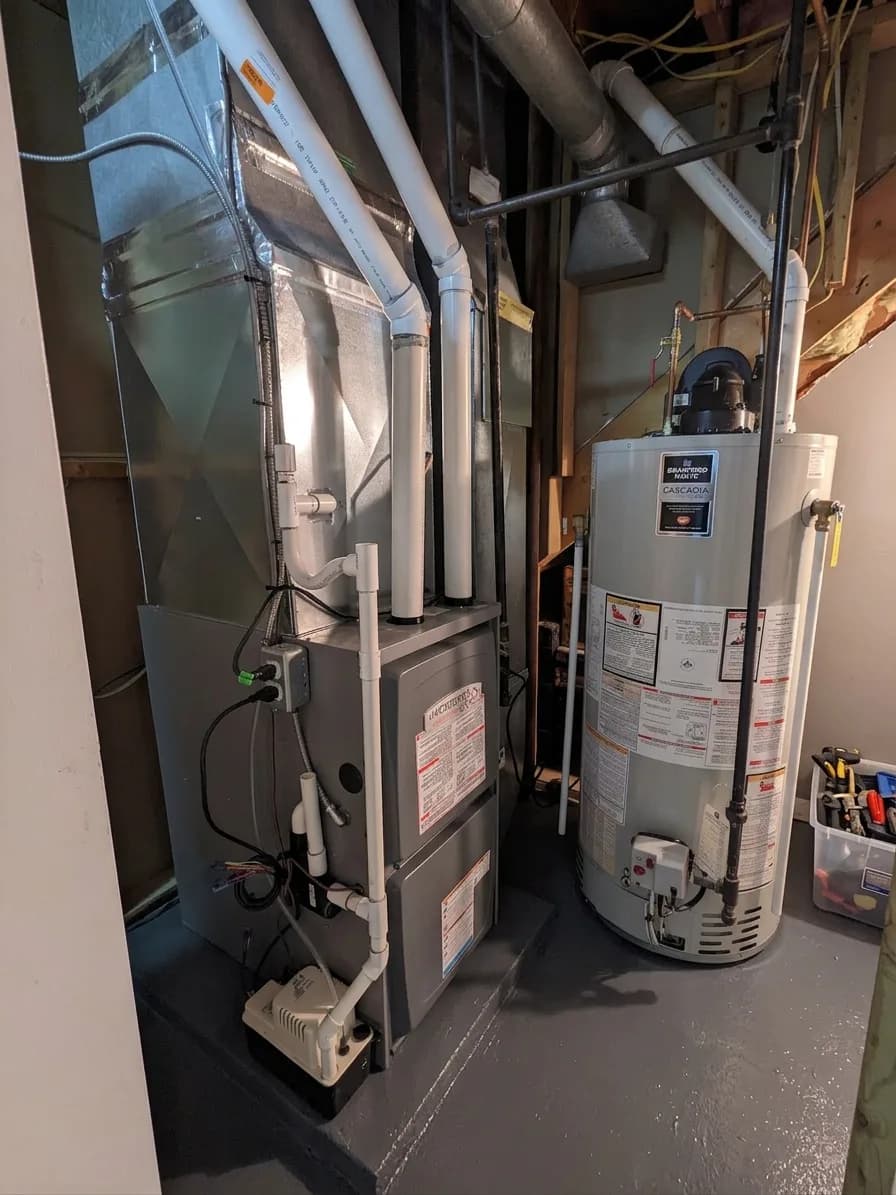
High-efficiency furnaces produce condensation as they burn gas, and that condensation drains through a small plastic tube to a floor drain. If the drain backs up — algae growth, debris, frozen tube near an exterior wall — the furnace shuts down on a safety switch.
- Look for a small clear plastic tube running from the furnace toward a floor drain
- If the tube is full of cloudy water that isn't moving, that's a backed-up drain
- If the tube runs near an exterior wall and you've had a really cold snap, it may be frozen
- A blocked condensate drain needs a technician — don't try to disassemble the trap yourself unless you know what you're doing
6. Check the vent pipes outside
Modern high-efficiency furnaces vent through PVC pipes that terminate on an outside wall. If snow or ice is blocking those vents, the furnace will shut down on a safety switch.
- Find the white PVC pipes coming out of your exterior wall (usually two pipes — one intake, one exhaust)
- Make sure they're clear of snow, ice, leaves, or debris
- Clear at least 12 inches of space around the openings
- If there's a heavy ice ring around the vent, melt it off carefully — don't chip at it with a sharp tool
7. Listen for the startup sequence
When you turn up the thermostat, does anything happen at the furnace?
- You hear the inducer fan start (a quiet whoosh) then nothing else — the burner isn't firing. Could be a flame sensor, igniter, or gas valve issue. Needs a tech.
- You hear nothing at all — power issue (steps 2-3) or thermostat issue (step 1) or a failed control board.
- You hear the burner light, then shut off after a few seconds — flame sensor issue, very common. Quick repair.
- You hear the burner light, but cold air blows from the vents — the blower is starting before the heat exchanger is hot. Usually a control board or sequencer issue.
When to skip the checklist and just call
Stop and call immediately in any of these situations:
- You smell gas — leave the house, call your gas utility's emergency line first, then us
- You hear a loud bang or boom when the furnace tries to ignite
- The breaker trips immediately every time you reset it
- You suspect a carbon monoxide leak (a working CO detector is essential — replace the batteries if it's been a year, and replace the whole unit every 7-10 years per the manufacturer)
- The flame is yellow or orange instead of blue
- It's -20°C outside and your house is dropping fast
The most common actual fixes
Of the calls that get past the homeowner checklist and need a service visit, the most common fixes are:
-
Flame sensor cleaning or replacement — easily the #1 winter no-heat fix. The flame sensor is a small metal rod inside the burner area that confirms the flame is lit. It gets coated with gunk over time and stops detecting flame, so the furnace shuts off the gas valve as a safety. Cleaning takes 10 minutes. Replacement parts are cheap.
-
Igniter replacement — the hot-surface igniter that lights the gas burner. Igniters have a finite lifespan and tend to fail in cold weather when they're working hardest. Usually a 20-30 minute repair.
-
Capacitor replacement — capacitors run the blower motor. When they fail, the blower doesn't spin and the safety switches shut the burner down. Quick repair.
-
Control board replacement — less common but more expensive. The control board is the furnace's computer. When it fails, the furnace doesn't know what to do.
-
Pressure switch issues — often actually a condensate drain or vent obstruction (see steps 5 and 6 above) rather than the switch itself failing.
-
Cracked heat exchanger — rare but serious. The heat exchanger separates combustion gases from the air going into your home. A cracked exchanger can leak carbon monoxide. We don't patch cracked exchangers — they're a furnace-replacement situation. See our guide on the $5,000 rule for repair-vs-replace economics.
What to have ready when you call
A few details speed up the diagnostic:
- The age of your furnace (rough is fine — "around 12 years")
- The make and brand (often printed inside the furnace door)
- What you've tried from the checklist above
- Whether you smell gas (call gas utility first if yes)
- What time the furnace stopped working
- Whether anything unusual happened recently — power outage, contractor in the basement, new appliance install
After the repair
Once we've fixed whatever's broken, we'll usually recommend:
- An annual tune-up — most failures we see in January would have been caught at a fall tune-up. See our furnace tune-up page.
- Setting a calendar reminder for filter changes — every 1-3 months depending on filter type and household conditions
- Checking the age of your CO detector — if it's over 7 years old, replace the unit (batteries aren't enough)
When repair stops making sense
If your furnace is over 15 years old and you're paying $500+ for repairs more than once every few years, it's worth running the repair-vs-replace math. See our $5,000 rule explainer for the simplest version of that math, or our new furnace cost guide for replacement pricing.
Furnace is still not heating?
Request a service call and mention "no heat" in the message — we'll prioritize. Same-day when scheduling allows. Service area: Woodstock + 30-minute radius. See furnace repair details for what to expect at the visit.
Common Questions
Frequently asked
My furnace stopped heating. What should I check first?
Start with the thermostat (set to HEAT, temperature above current room temp, batteries good). Then check the furnace power switch (near the unit, sometimes bumped off), the breaker (look for one tripped mid-position), and the filter (replace if completely plugged — a plugged filter trips the safety limit switch).
Why is my furnace turning on but blowing cold air?
Common causes: thermostat is set to Fan instead of Auto, the burner isn't lighting (igniter or flame sensor issue), the gas valve isn't opening, or the heat exchanger is cracked (safety shutdown). A cracked heat exchanger is a safety issue — shut the unit off and call.
What is the most common furnace repair?
Flame sensor cleaning or replacement is the most common winter no-heat fix. The flame sensor confirms the burner flame is lit; it gets coated with gunk and stops detecting flame, so the furnace shuts the gas valve as a safety. Cleaning takes 10 minutes. Replacement parts are inexpensive.
When should I worry about carbon monoxide?
Always have working CO detectors near sleeping areas — replace the batteries annually and the whole unit every 7-10 years per the manufacturer. If a CO detector alarms, the flame is yellow/orange instead of blue, or you smell unusual furnace odours: leave the house, call your gas utility's emergency line, then call us. CO leaks can be caused by cracked heat exchangers, blocked venting, or improper combustion.
How long does a furnace repair take?
Common quick repairs (flame sensor, igniter, capacitor, thermostat issues) usually take under 2 hours. Larger repairs (control board, blower motor, heat exchanger) can run half a day or require ordering parts.
Should I just replace an old furnace that keeps breaking?
Multiply the unit's age by the repair cost. If the number is over $5,000, replacement usually wins on long-term economics. Read more on the $5,000 rule and how to weigh repair vs replace.